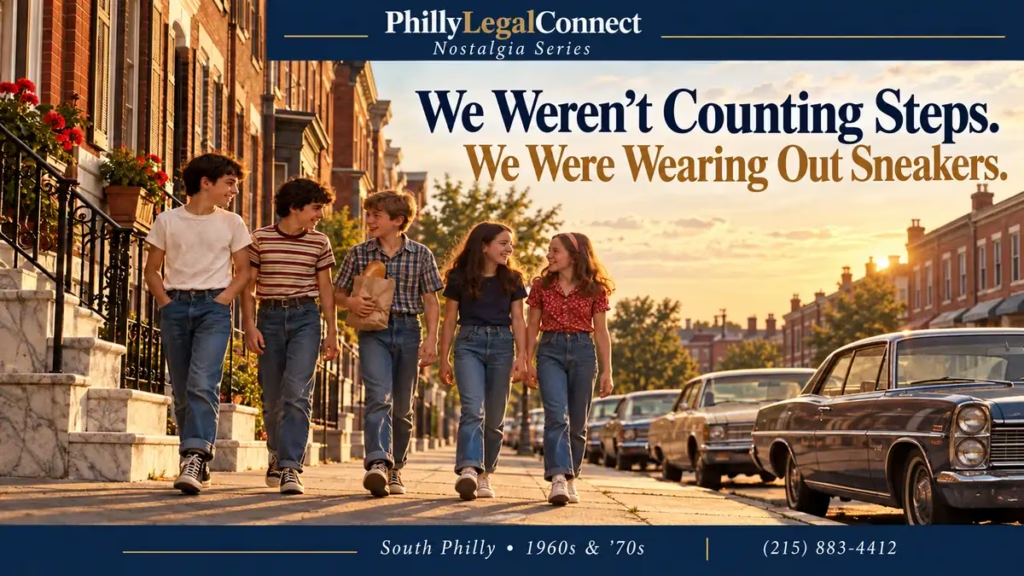
Walking in South Philly was part of everyday life in the 1960s and ’70s. We walked to school, ran errands, raced our friends, and wore out our Converse—without ever counting a step.
Part of the PhillyLegalConnect Nostalgia Series
Remembering the neighborhoods, parishes, playgrounds, family traditions, and everyday experiences that made Philadelphia home.
Today, we have Apple Watches, Fitbits, and all sorts of trackers telling us how many steps we have taken. We check our wrists, set daily goals, and congratulate ourselves when we reach them.
Growing up in South Philly, we had a different system.
Our mothers told us to go somewhere, and we went.
And we walked.
I sometimes think I walked more in a day back then than I do now in a week. That might be stretching it a little, but anyone who grew up in the neighborhood knows what I mean.
We weren’t counting steps. We were wearing out sneakers.
Walking in South Philly: Nobody Asked Who Was Driving
School, church, the playground, the candy store, your grandmother’s house—you walked.
You walked to get bread. Some of us even got sent to buy cigarettes for our fathers. That was a different time.
Rain? You walked.
Snow? You walked.
Cold out? Put your coat on. You still walked.
In our house, getting somewhere usually started with opening the front door and heading down the steps to the pavement. A ride wasn’t something you automatically expected.
And with family, friends, stores, churches, and playgrounds scattered throughout the neighborhood, there was always somewhere to go.
15th and Shunk to Bishop Neumann
When I was in high school, we lived at 15th and Shunk. Bishop Neumann was at 26th and Moore.
That was a hike.
We walked up 15th to Snyder, over to 26th Street, and then up to Moore. When school was finished, we walked home again.
No watch recorded it. There was no little celebration on a screen when you reached your daily goal.
You got home—and there was a good chance somebody had another place for you to go.
“While You’re Here, Go to the Store”
How many times did you walk into the house and barely get through the doorway before you heard:
“Go to the butcher shop.”
Or:
“Go to the drugstore.”
Our pharmacy was Overbeck’s, on the corner of Broad and Porter. So out the door you went again.
Need bread? Walk to Cacia’s at Mole and Ritner.
There was always an errand. And somehow, the fact that you had just walked home from somewhere else didn’t count toward getting out of it.
You could have covered half of South Philly that afternoon.
Your mother still needed something from the store.
Our Converse Sneakers Got a Workout
If we were playing ball down at DV, at 18th and Bigler, we walked.
Then we played ball.
Then we walked home.
The walk was just how you got to the exercise.
Want a water ice from Pop’s on Oregon Avenue? Start walking.
Church at St. Monica’s at 17th and Ritner? You knew the way.
And in our house, you had two pairs of sneakers for the year. One pair before the summer and another in the fall or early winter.
Those sneakers had to last.
As far as we were concerned, choosing your Converse was easy. Two colors: black or white. Two styles: low-cut or high-tops.
Pick your color. Pick your style. You were done.
Some people called them “Chucks,” short for Chuck Taylors. We went to Alvie Rainbow’s on Broad Street to get our sneaks.
Then you wore them everywhere—playing on the street, on ball fields and basketball courts, at playgrounds, running errands, and walking all the blocks in between.
And When We Weren’t Walking, We Were Running
Getting home didn’t necessarily mean sitting down. If your friends were outside, you went back out.
You were either hanging on the corner or up the street. There was halfball, fastball, street hockey, and two-hand touch on Shunk Street. We played jailbreak. We played hide the belt.
And sometimes, just going somewhere turned into a race.
“Race you to the store.”
“Race you to the fireplug.”
“Race you to the park.”
And off we went.
Nobody timed us. Nobody organized it. We all knew who the fastest runner was.
Kids know kids. We didn’t need our parents telling us what they thought.
Running was just another everyday thing we did. You could spend the whole day walking to school, running errands, and playing ball—and still take off because your friend said, “Race you.”
Imagine what a step tracker would have recorded.
Those two pairs of Converse never stood a chance.
Editor’s Note — A Final Resting Place for Our Sneakers
When our sneakers finally gave up the ghost, we gave them a proper neighborhood burial. We tied the shoelaces together and threw them up over the telephone wires, where they would hang.
After all those school walks, errands, ball games, and “race you to the store” trips, they had earned their retirement.
— Tom Oakes
Even Going to the Movies Meant a Walk
A trip to the movies had its own route.
Maybe you were going to the Broadway at Broad and Snyder. Maybe it was the Colonial on Moyamensing Avenue.
Either way, getting there was part of the outing.
You walked with your friends, talked along the way, watched the movie, and walked back. There was plenty to talk about on the way home, too.
We knew the neighborhood from the pavement: the corners, the storefronts, the places where someone you knew might be sitting outside.
You learned where things were because you had walked there yourself.
Going to the Phillies Game? We Walked There, Too
Later, when the Phillies were playing at Veterans Stadium, that was another walk.
From 15th and Shunk, we headed down toward the stadium. Going to a ballgame didn’t automatically mean getting into a car. We had two feet and knew where we were going.
We walked to the Vet, watched the Phillies, and walked home.
Add that to the walks to school, errands, playground visits, and street games, and you begin to wonder how those sneakers ever made it through the year.
Going Fishing? Keep Walking
Then there were trips to the Lakes—FDR Park.
From our neighborhood, we would head straight down Broad Street toward Broad and Pattison. But reaching Pattison didn’t mean you had reached your fishing spot.
You still had to walk into the park.
In my memory, the Lakes felt enormous. I picture the whole stretch down toward the Navy Base and west toward the golf course, with Packer Park Swim Club beyond. Farther out were the Penrose Bridge and the way over toward Southwest Philly, where Jerry’s Corner was another familiar landmark.
As a kid, that whole area felt like a world to explore.
And we explored it on foot.
After walking down there and spending time fishing, you still had the trip home ahead of you.
Nobody was checking whether you had enough steps left in you.
Walking Around South Philly Meant Knowing the People
Walking around South Philly meant seeing people you knew.
You passed relatives, neighbors, family friends, and kids from school. You stopped to talk. You met somebody heading in your direction and walked together.
In my case, both sets of grandparents lived directly across the street from us on Shunk Street. At least those visits gave my sneakers a break.
But across the neighborhood, our daily routes connected all the parts of our lives: school, parish, family, friends, and the stores our parents sent us to.
That is part of what I remember most. We knew the streets, but we also knew the people on them.
So, How Many Steps Did We Take?
I honestly couldn’t tell you.
We didn’t measure the walk to school, the trip to the pharmacy, the races down the street, or the extra blocks for a water ice. Nobody added them up.
But put a tracker on that South Philly kid for one ordinary day, and I would love to see the number.
Especially on a day when he finally got home, sat down, and heard:
“Go get bread.”
Where did your South Philly sneakers take you? What was your school walk—and who was the fastest kid on your block?
Related Nostalgia Articles
Keep the memories going:
- Halloween in 1960s South Philly: Pillowcases, Parish Neighborhoods and Candy Bars — Homemade costumes, pillowcases full of candy, and Halloween in our parish neighborhoods.
Explore more stories about the streets, schools, families, and traditions that shaped us on the Philadelphia Nostalgia page.
Our Neighborhoods. Our Memories.
The PhillyLegalConnect Nostalgia Series celebrates the streets, schools, parishes, playgrounds, local businesses, and family traditions that shaped life in Philadelphia.
Through personal recollections and shared neighborhood memories, we keep those connections alive—and invite readers to remember their own experiences.
About the Author
Thomas G. Oakes, editor of PhillyLegalConnect, grew up in South Philadelphia and attended both Bishop Neumann and Southern High. His neighborhood stretched from river to river—from Front Street near the Delaware to 30th Street near the Schuylkill.
Life took him beyond South Philly, too—to basketball games at St. Joe’s, Eagles games at Franklin Field, and gathering places throughout the city. His stories draw on personal memories of family, friends, schools, parishes, sports, music, and the everyday experiences that made Philadelphia home.
More about Thomas G. Oakes and his articles →
Explore PhillyLegalConnect
Our memories begin in Philadelphia’s neighborhoods, but they don’t stop at the city limits. For so many Philadelphia families, summer meant going down the Shore—day trips, weekends, a week’s vacation, or summers spent at a second home.
Explore more neighborhood memories, along with practical information about safety, accidents, insurance, and injury questions at home and down the Shore.
Philadelphia Nostalgia — More Neighborhood Memories
Philadelphia Neighborhood Safety
South Jersey & Jersey Shore Injury Guide
PhillyLegalConnect Quick Answer Series
When You Need Legal Help
If you need legal representation after an accident or injury, learn more about The Oakes Firm or call (215) 883-4412.
About These Memories: Nostalgia articles reflect the author’s personal recollections. Experiences, neighborhood names, and remembered details may differ among readers. We welcome your memories and corrections.
PhillyLegalConnect provides general informational and educational content. Thomas G. Oakes is not an attorney. Content on this site is not legal advice, and reading it does not create an attorney-client relationship.