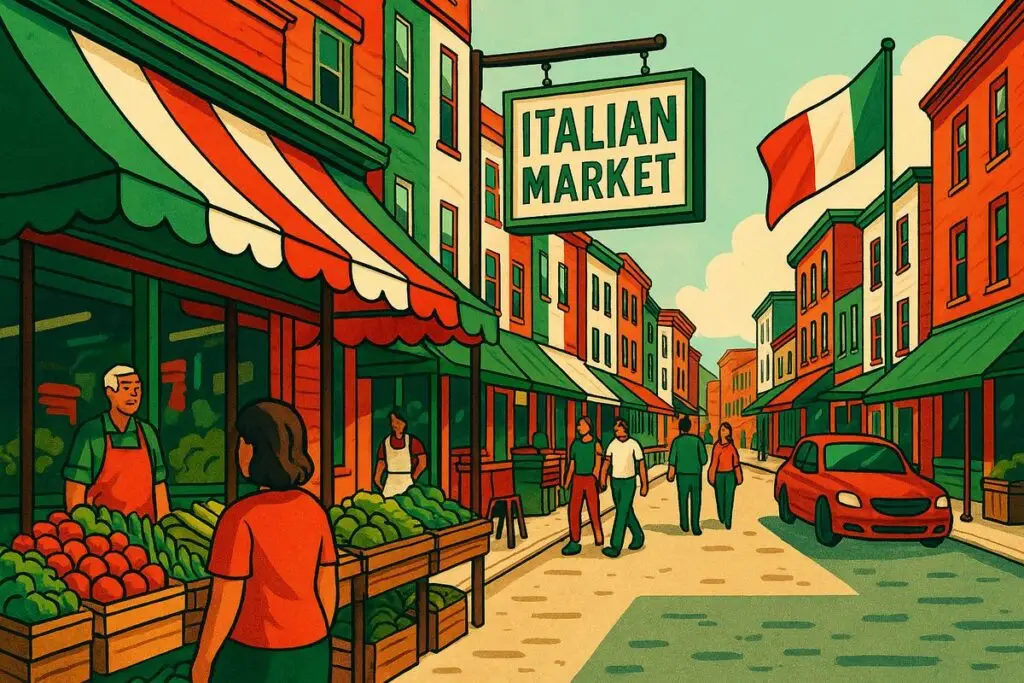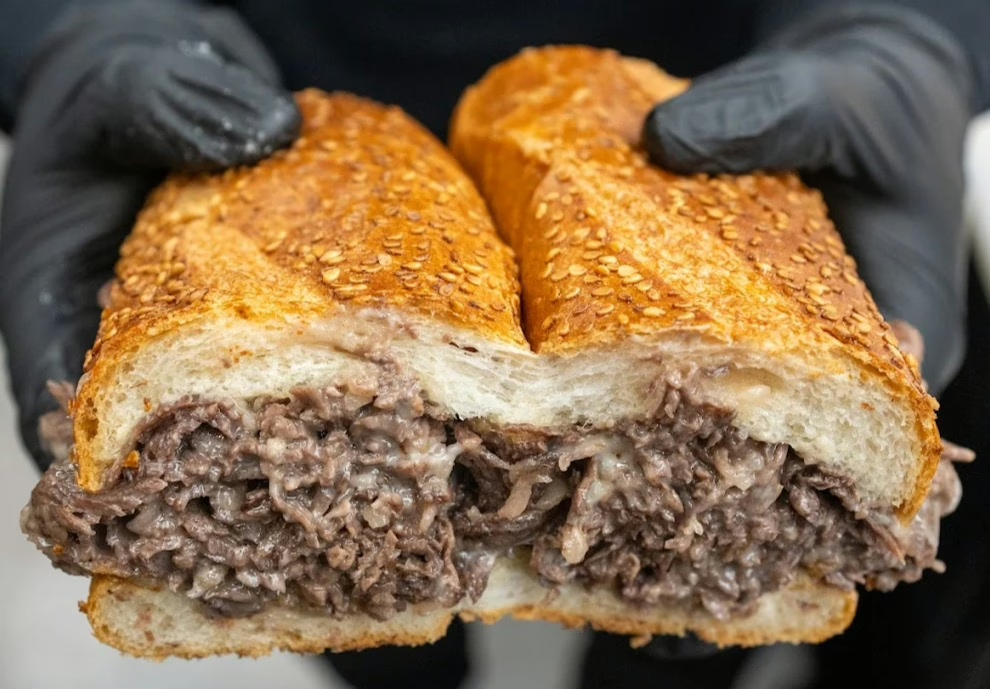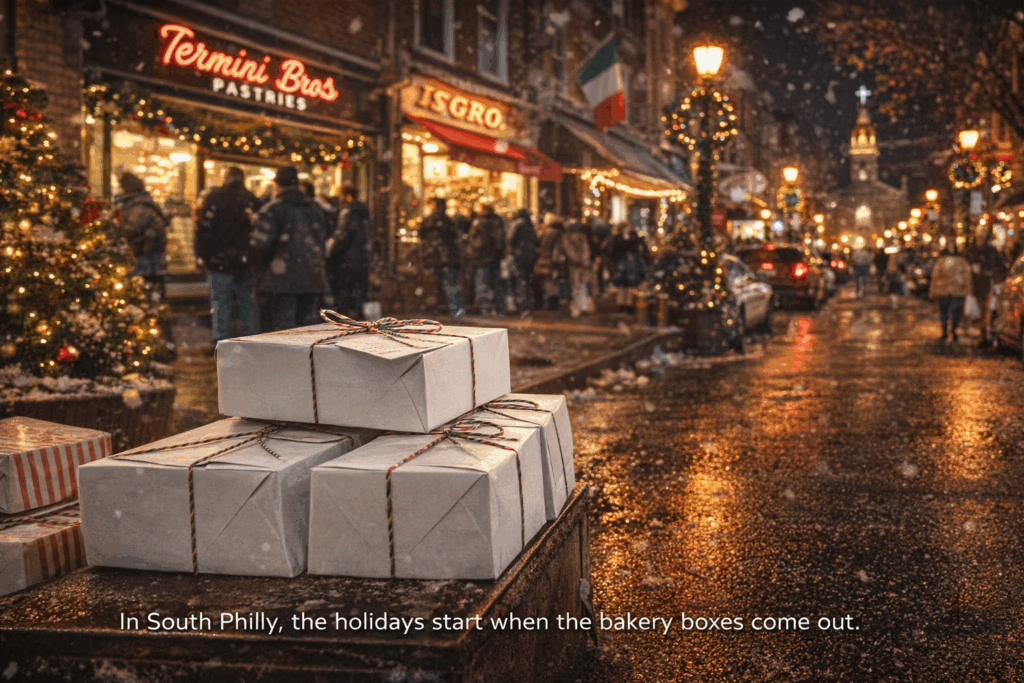
In South Philly, there are a lot of ways to measure the holidays—but my favorite has nothing to do with a calendar.
Quick Answer: In South Philly, Christmas traditions often mean holiday bakery runs to Termini’s and Isgro’s, seafood and bread stops (including Ippolito’s), the Feast of the Seven Fishes on Christmas Eve, and Midnight Mass—followed by coffee and pastries back at the kitchen table.
Key Takeaways
- In South Philly, Christmas “starts” when bakery lines form and the white boxes come out.
- Marrying into an Italian family introduced me to a whole new Christmas Eve rhythm—Termini’s, Isgro’s, fish and bread.
- Midnight Mass was always part of our tradition.
- The Feast of the Seven Fishes isn’t just a meal—it’s a tradition built around showing up for people.
- Holiday crowds + winter sidewalks + double-parking = real accident risk. Slow down, watch your footing, and cross carefully.
You know Christmas is here when the lines at Termini’s and Isgro’s stretch down the block, people are double-parked like it’s a sport, and nobody even seems mad about it.
That’s the real sign: the neighborhood is in motion.
And for me, the holidays didn’t fully “click” until I married into an Italian family—and learned the South Philly Christmas routine from my father-in-law, Sal, who lived about ten doors down from us. Our Christmas was on Christmas. Sal’s was all about Christmas Eve.
I grew up here. I visited all of our neighbors, but this was his tradition—different from my family’s, and absolutely unforgettable once you’re part of it.
Sal’s Holiday Route: “We don’t go to one bakery—we go to both.”
I’d been to the bakeries before, sure. But going with Sal in December was something else.
This wasn’t a quick stop.
This was a holiday mission—a series of runs, each one with a purpose.
And the rule was simple:
You don’t just go to one bakery.
You go to both.
We’d bounce between Termini Brothers Bakery on South 8th Street (near 8th & Dickinson) and Isgro Pastries at 10th & Christian, then swing by Ippolito’s on Dickinson Street for fish before heading home to cook
Because Sal believed every table needed a little bit of everything:
- Termini’s for the bigger cakes and trays that could feed a crowd
- Isgro’s for the mini cannoli, pignoli cookies, amaretti, and the boxes that always disappeared first
And we weren’t buying dessert for one night.
We were buying enough to cover Christmas Eve and Christmas Day—because in a South Philly house, you never want to be the one who runs out of cannoli halfway through a visit.
That’s when the real, unspoken planning started:
- “Do we have enough for tomorrow.” “Yes. We have lots of boxes.”
- “You don’t need to put those aside.”
- “Make sure the kids get them.”
- “Don’t open that box yet—company’s coming. over shortly.”
By the time we were done, the white boxes were stacked, the string was cutting into my fingers, and Sal would grin like:
Now you get it.
The Art of the Line (and the Parking)
You didn’t just “stop by” the bakeries at Christmas.
You committed.
You circled blocks and watched for brake lights like it was a treasure hunt. You took your chances on a double-park and tossed out the classic:
“I’ll just be a minute!”
Then you joined the line—because the line was part of the tradition.
At Termini’s, people compared whose grandmother made the best struffoli or lasagna.
At Isgro’s, somebody always debated whether the pignoli cookies were worth the price.
(They were.)
And at both places, there was always someone explaining it to an outsider like it was a history lesson:
“They’ve been here forever. This is just what you do.”
Every time the door opened, the smell hit you—espresso, sugar, almond paste, anise—drifting right out onto the street.
And even if you didn’t know anyone in line, for that hour you were part of the same South Philly family.
Ippolito’s, Good Bread, and Why the Loaves Matter
Of course, the bakeries were only part of the day.
No Christmas Eve was complete without a stop for fish—and a stop for real Italian bread, because the loaves matter more than people admit. We would stop at Cacia’s or Sarcone’s for our bread…or both. Ippolito’s for fish.
In our world great Italian bread meant: good crust, good crumb, and bread that can handle red gravy and a table full of hands tearing pieces off without thinking.
This is the part that still makes me smile, because it shows the difference between traditions:
My family’s Christmas was Christmas. We had Turkey on Christmas Day. We had our own traditions. My mother and grandmother would make stuffing, bake pies and we always had biscuits. Our Christmases were great, but they were different than at my father-in-law’s house.
Sal’s Christmas was a system—built from experience, pride, and the belief that food is how you take care of people.
The Feast of the Seven Fishes: “Seven means seven… Maybe”
Then came the Feast of the Seven Fishes.
Some families say “seven” and mean “a lot.”
In Sal’s tradition, seven meant seven or maybe eight or nine.
And one of the dishes was always pasta—because you can’t do Christmas Eve without something that looks like it simmered all day.
Here’s what “seven fish” could look like at our table:
- Baccalà (salted cod) — soaked and cooked, sometimes in sauce, sometimes fried
- Calamari — fried or in sauce, piled high on a platter
- Shrimp — scampi or cocktail depending on who was coming
- Smelts — fried, crisp, eaten like French fries
- Clams — often served with pasta
- Clams and macaroni (aglio e olio) — simple, garlicky, perfect
- “Alegge” gravy (small sardines) — cooked down into a red gravy people remember for years
- Lobster tails
- Flounder – Fried
The kitchen was warm. The house smelled like garlic, tomatoes, and the sea.
The table was loud, crowded, and perfect.
Midnight Mass: The Second Half of Christmas Eve
After dinner, the coffee pot went on.
That’s when the pastry boxes finally came out—and you heard the real South Philly rules:
- “Eat as much as you want.”
- “We have a lot of cakes and we’ve got a lot of people.”
- “We have more cakes, so don’t worry, they wont disappear tonight.”
- “Put the mini cannoli out on the table. Those are from Isgro’s.”
Then it was time for Midnight Mass.
Whether it was St. Monica’s, St. Rita’s, Epiphany, Stella Maris, St. Gabe’s, Annunciation, St. Edmond’s, Our Lady of Mount Carmel, St. Nick’s or another neighborhood parish, the churches were packed—coats over arms, kids half-asleep and half-wired from sugar.
When Mass ended, everyone walked back out into the cold night, the streets shining under the streetlights—knowing there was coffee, cake, cannoli, and family waiting back at the kitchen table.
A Quick Holiday Safety Reminder (South Philly Edition)
The same holiday crowds that make South Philly special can also make things hectic:
- double-parking and sudden door swings
- people crossing between cars with hands full of boxes
- winter sidewalks that turn slick after rain or snow
- uneven pavement, curb cuts, cellar doors, and poorly lit corners
If you’re carrying pastries, juggling bags from the fish market, walking with kids, or helping an older relative:
slow it down and watch your footing—especially near curbs and corners.
When a Holiday Tradition Turns Into an Injury
If you or someone you love is injured in Philadelphia—on a sidewalk, in a parking lot, or on the road—
The Oakes Firm should be your first call for injury law.
Call (215) 883-4412 or use the button below to connect.
FAQs
What are classic South Philly Christmas traditions?
Holiday runs for fish, bread, and pastries; the Feast of the Seven Fishes on Christmas Eve; and Midnight Mass at a neighborhood parish—plus the ritual of bringing home the white bakery boxes tied with string.
Why do South Philly families go to both Termini’s and Isgro’s?
Because each bakery has its own “must-haves.” Many families like having variety—cakes and trays from one stop, mini cannoli and specialty cookies from the other.
What is the Feast of the Seven Fishes?
A Christmas Eve tradition in many Italian-American homes featuring multiple seafood dishes—often including pasta—shared as a family meal before Midnight Mass.
What are common Seven Fishes dishes?
Baccalà, calamari, shrimp, smelts, clams or mussels with pasta, and other seafood dishes depending on family tradition.
Why is Christmas week in South Philly so busy around the Italian Market area?
Because families are picking up the last important things for Christmas Eve and Christmas Day—fish, bread, and pastries—and the neighborhood becomes one big holiday run.
What safety risks are most common during South Philly holiday errands?
Slips on wet/icy sidewalks, trips on uneven pavement or cellar doors, parking-lot falls, and car accidents caused by rushing, double-parking, and distracted driving.
He is a nationally recognized leader in courtroom technology, a certified TrialDirector trainer, and has taught lawyers, judges, and law students across the country — including at Temple University’s LL.M. in Trial Advocacy program and through major legal organizations such as the FDCC, IADC, and ABA. Tom has also lectured for the Delaware County Bar Association, the Gloucester County Bar Association in New Jersey, and presented for The Legal Intelligencer at Philadelphia’s Union League and other venues, speaking on trial technology, visual advocacy, and modern courtroom presentation.
Through PhillyLegalConnect and PhillyLegalNews, Tom blends his courtroom experience, technology expertise, and deep Philadelphia roots to help injured individuals and their families better understand the legal system — and connect with trusted trial lawyers when it matters most.
To read more about the author, visit the full biography here: https://phillylegalnews.com/about-the-editor/