
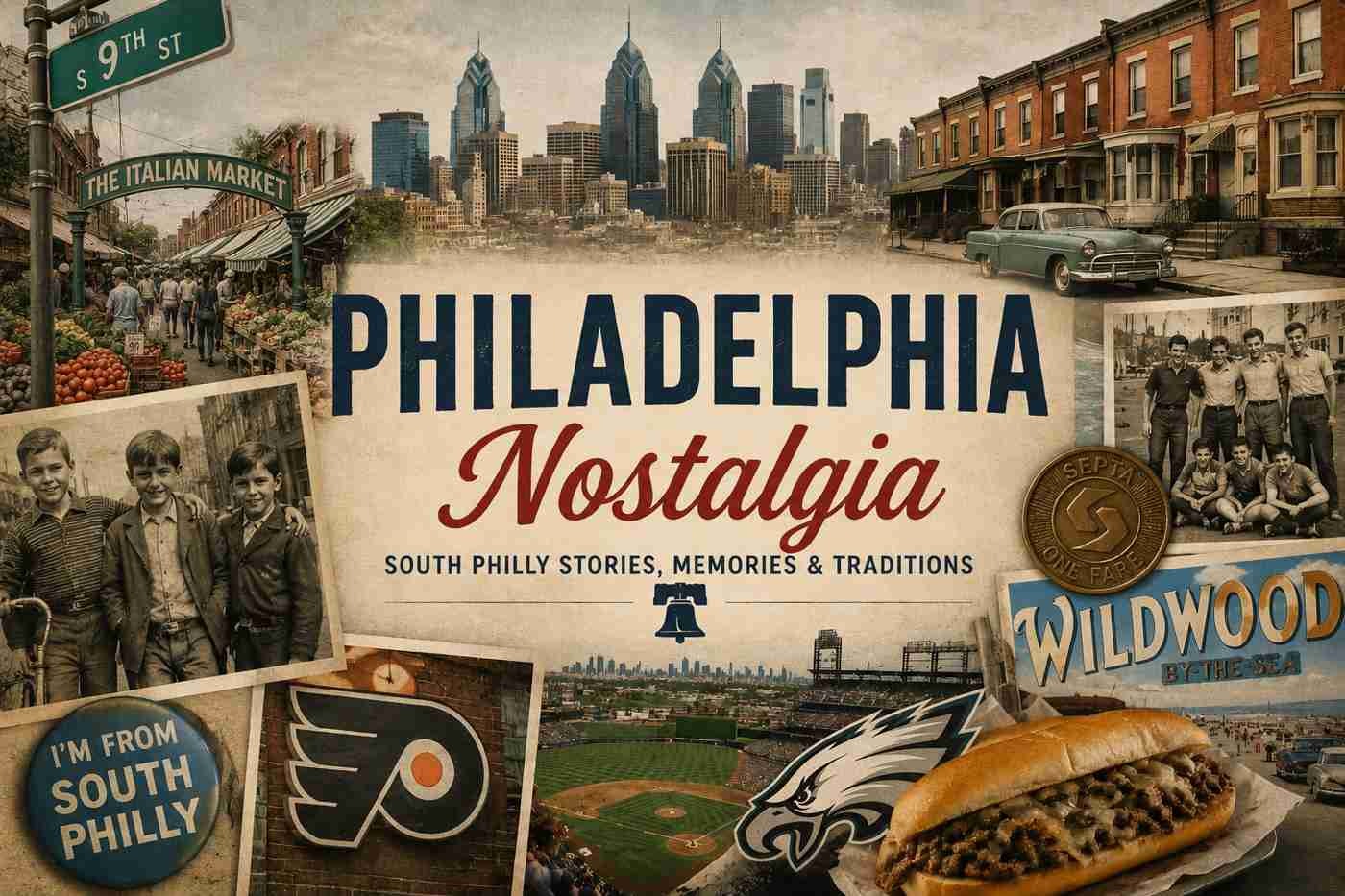
Philadelphia nostalgia is more than memories — it is the lived experience of growing up in South Philly, traveling through Center City, walking to school in every kind of weather, crossing the Walt Whitman Bridge on the way to the Shore, playing sports at neighborhood playgrounds, gathering at diners and pizza shops, and building a life shaped by Philadelphia’s neighborhoods, traditions, food, music, and people.
This page brings together real stories, landmarks, routines, and memories from across Philadelphia and the surrounding region — preserving not just what the city looked like, but how it truly felt to live here.
Key Takeaways
- Philadelphia life was built around neighborhoods, parishes, playgrounds, schools, food, music, and traditions
- South Philly served as the foundation, but life extended throughout Philadelphia, South Jersey, and the Jersey Shore
- Food, sports, movie houses, clubs, and gathering places shaped generations of Philadelphians
- Many landmarks and traditions still exist today, even as the city continues changing
- This page serves as a living Philadelphia memory archive built from firsthand experience
Introduction
Philadelphia wasn’t just a place you lived — it was a place that shaped you.
If you grew up in South Philadelphia during the 1950s, 1960s, and 1970s, life revolved around neighborhoods, schools, parishes, playgrounds, street corners and corner stores, diners, bakeries, movie houses, sports, and routines that became part of your identity.
You walked everywhere.
You knew every alleyway, shortcut, and playground. Families stayed close. Entire neighborhoods were tied together through churches, schools, food traditions, sports leagues, and local gathering places.
South Philly was home — but life stretched far beyond it.
Center City, Old City, the Jersey Shore, Wildwood, Ocean City, Margate, Somers Point, South Jersey clubs, Franklin Field, Veterans Stadium, FDR Park, and countless neighborhood landmarks all became part of growing up in Philadelphia.
This page is designed as a living archive of those memories and experiences.
Editor’s Note
My family and extended family were a large part of our neighborhood and the surrounding South Philadelphia parishes.
My father was one of ten children. My mother was one of five. I was one of four children myself — and that was common in South Philly during that era.
I had aunts, uncles, cousins, and extended family members living on almost every nearby street. Many families had five, six, or seven kids, and entire neighborhoods often revolved around family connections, parish life, schools, playgrounds, and lifelong friendships.
That closeness shaped how people grew up, how neighborhoods functioned, and how generations of Philadelphians experienced the city.
— Thomas G. Oakes
South Philly Roots
Passyunk Avenue, Oregon Avenue & Neighborhood Life
South Philadelphia revolved around neighborhoods and commercial corridors that became part of daily life.
Passyunk Avenue — “The Avenue” — was where families shopped, walked, gathered, and ran into neighbors.
Oregon Avenue became another major South Philly shopping corridor during the 1950s, 1960s, and 1970s.
Landmarks included:
- Robert Hall
- Penn Fruit
- Sears
- Lit Brothers
- Atlantic Thrift Store
- Willie Mosconi’s pool hall
- Neighborhood five-and-ten stores
- Local bowling alleys
Neighborhood gathering places became woven into everyday life:
- Penrose Diner
- The Martinique
- The Bocce Club
- The Boys Club at Moyamensing/Shunk
- Palumbo’s reception hall
👉 Read More:
Parishes, Family & Generational Identity
St. Monica’s, St. Richard’s, Annunciation, Epiphany, St. Edmund’s, St. Nick’s, Our Lady of Mount Carmel, St. Gabe’s, Stella Maris, Holy Spirit and many other parishes became an important part of neighborhood life and family history.
Girard Estate and Packer Park developed their own identity within South Philly. The Girard Estate had larger homes and tree-lined streets. All had strong neighborhood traditions.
These neighborhoods helped shape generations of Philadelphia families.
Schools, Walking the City & Growing Up
There were no drop-off lines.
Kids walked.
Rain, snow, heat, sleet, or shine — children walked to school every day and learned the city block by block.
Bishop Neumann High School, Southern High School, neighborhood parish schools, and Center City schools became part of that daily rhythm.
Walking through Philadelphia neighborhoods taught generations of kids:
- alleyways
- shortcuts
- playground routes
- neighborhood boundaries
- city awareness
👉 Read More:
- Walking to Bishop Neumann
- South Philly School Life
- Growing Up on South Philly Streets
Playgrounds, Sports & Neighborhood Competition
Before organized travel teams and year-round sports specialization, Philadelphia kids played where they lived.
We played football, baseball, and basketball in the streets, at neighborhood playgrounds, parks, schoolyards, and local fields. Sports were deeply connected to neighborhood identity, and entire childhoods were shaped around pickup games, playground rivalries, and local athletic leagues.
Delaware Valley Youth Athletic Association — known simply as “DV” — at 18th and Bigler became a second home for many South Philly kids. Football, basketball, and baseball were part of everyday life there, and generations of neighborhood friendships were built on those fields and courts.
Guerin Playground near 16th and Jackson Streets became another major gathering place. With both indoor and outdoor basketball courts, it drew kids from across the neighborhood. I played there almost every Saturday for years.
Other important neighborhood sports and recreation landmarks included:
- Johnson’s Field/Barry Playground
- Bregy Schoolyard & Stephen Girard Schoolyard
- Dixon House
- 16th and Jackson – Guerin
- St. Monica’s gym and bowling alley
- The Boys Club at the triangle of Moyamensing, Shunk, and 13th Street
These playgrounds and neighborhood sports programs taught competition, toughness, friendship, discipline, and community. They were far more than places to play — they helped shape generations of South Philadelphia kids.
👉 Read More:
- Fireplugs, Half Ball & Street Summers
- DV, Guerin Playground & South Philly Sports Culture
Food, Bakeries & Neighborhood Gathering Places
South Philly Food Culture
Food in South Philadelphia wasn’t just about restaurants.
It was part of everyday life.
Families knew the owners, workers, and regular customers. Certain places became part of neighborhood routines and lifelong memories.
Cheesesteaks, Roast Pork & Hoagies
Legendary South Philly names included:
- Pat’s
- Geno’s
- Tony Luke’s
- Philip’s
- Cabana Steaks
- Ishkabibble’s
- Jim’s
- Annie’s
- Nick’s Roast Beef
- John’s Roast Pork
- Red’s Hoagies
- Primo Hoagies
- Skinny Joey’s
Pizza Shops, Bakeries & Neighborhood Traditions
Pizza culture became part of neighborhood identity:
- Pizza Shack (“The Shack”)
- Celebre’s (“Celebreeze”)
- Marra’s
- Napoli’s
- DiFabio’s
- Cacia’s Bakery
- Termini Brothers
- Isgro’s
- Mancuso’s
Cacia’s tomato pies and Friday pizza traditions became especially important during Lent.
The Pizza Shack story — including Chuck Forte introducing strombolis into neighborhood life — became one of the most memorable South Philly food stories of all.
Diners, Water Ice & Local Favorites
Neighborhood favorites included:
- Penrose Diner
- Melrose Diner
- Oregon Diner
- Millie’s
- Pop’s Water Ice
- Federal Pretzel
- Walt’s Crabs
- South Philly Grill
- Geno’s hamburgers
- The Steer-In
👉 Read More:
- South Philly Pizza, Home-Phone Orders & August Shore Summers
- Skinny Joey’s & Neighborhood Food Culture
- South Philly Food Traditions
Movie Houses, Entertainment & Neighborhood Nights
Before streaming, neighborhoods gathered at local movie houses.
Theaters became social landmarks:
- The Savoy
- The Broadway Theater
- The Colonial
- The President
- Bambi’s Theater
- The Steer-In
Kids spent Saturdays at double-features, matinees, and neighborhood movies with friends and family.
👉 Read More:
- South Philly Movie Houses & Saturday Nights
Music, Clubs & the Philadelphia Show-Band Circuit
Music was another major part of growing up in Philadelphia.
Before Fire & Ice, there was Little Richie’s Review, the first band I played with that worked the club circuit. It was an offshoot of a band called Bandstand, and we played a lot of 1950s music — songs like “Put Your Head on My Shoulder,” “Runaround Sue,” and the classic songs from the singers and groups of that era.
It was a show band, and I was only 15 years old.
Later, Fire & Ice, made up of local South Philly kids, played across Philadelphia, South Jersey, Delaware County, Chester County, and the Jersey Shore.
Venues and memories included:
- OBL Club on Broad Street in South Philly
- Sam D’Amico’s music shop on Moyamensing Avenue between 15th and 16th Streets
- Nicki D’s in Northeast Philadelphia
- Erlton Lounge
- T’s Pub
- McNally’s
- Tony Mart’s in Somers Point
- Mother’s in Margate
- Rainbow Room in Wildwood
- Pacific Avenue Rock Room in Wildwood
- Bishop Neumann’s Turkey Trot, the big Thanksgiving Eve dance
👉 Read More:
- Fire & Ice and the Philadelphia Club Circuit
- Little Richie’s Review and the Show-Band Years
- South Philly Music Memories
Sports, Stadiums & Philadelphia Family Connections
Sports were part of Philadelphia life at every level — playgrounds, high schools, colleges, and professional teams.
There were Eagles games at Franklin Field, Veterans Stadium memories, JFK Stadium, the Thrill Show, the Spectrum, Flyers games, Sixers games, concerts, and the Broad Street Bullies era.
The Spectrum deserves its own place in this story. It held Flyers hockey, 76ers basketball, concerts, and countless Philadelphia events that shaped an entire generation.
Basketball also ran through our family.
My Uncle Bill Oakes — my father’s youngest brother and the youngest of ten children — was a great basketball player. He played at Saint Joseph’s under Dr. Jack Ramsay, on teams that included Matt Guokas and Cliff Anderson. He later became an NBA referee. His jersey still hangs in the rafters at the Fieldhouse on St. Joe’s campus.
I used to go with my dad to see him play. Those games were part of Philadelphia’s Big 5 basketball culture.
Another uncle, Leonard, worked as the equipment guy for the 76ers.
Later, as I became a father, my children went to grade school and high school with members of the Hextall family. Ron Hextall, the Flyers goalie, lived in the neighborhood, and that was another reminder of how closely Philadelphia sports and neighborhood life often overlapped.
👉 Read More:
- Eagles Sundays at Franklin Field
- Big 5 Basketball and St. Joe’s Family Memories
- The Spectrum, Flyers, Sixers & Philadelphia Sports Culture
- Veterans Stadium and South Philly Sports Memories
FDR Park, The Navy Yard & City Change
FDR Park — “The Lakes” — became a huge part of South Philly childhood.
Kids:
- fished there
- ice skated there
- learned to drive there
The old Swedish Museum stood quietly in the park as another local landmark.
The Navy Yard also became part of South Philly life, with guarded entrances, PX visits, swimming facilities, and military culture.
The Broad Street subway extension into South Philly changed neighborhood movement forever, especially when the line expanded beyond Snyder Avenue toward Oregon and Pattison.
👉 Read More:
- FDR Park (“The Lakes”) Memories
- South Philly Transit & Subway Expansion
Shore Life & South Jersey Memories
For Philadelphia families, going “down the Shore” became a ritual.
Wildwood, Ocean City, Margate, and Somers Point became extensions of Philadelphia life itself.
Families crossed the Walt Whitman Bridge carrying beach chairs, coolers, food, and enough quarters for tolls.
Many South Philly kids still remember:
- holding their breath passing the old Hickory plant
- the pig farm smell along Route 42
- the excitement of reaching the Shore
Those sensory memories became permanently tied to summer.
👉 Read More:
- South Philly to Wildwood: Shore Memories
- Route 42, the Walt Whitman Bridge & Summer Trips
- Mack’s Pizza & August in Wildwood
Holidays, Traditions & Family Life
South Philadelphia traditions revolved around family.
Neighborhood traditions included:
- Thanksgiving Eve dances
- Turkey Trots
- Christmas visits
- Mummers Day
- New Year’s Day gatherings
- neighborhood bakeries
- family dinners
These traditions shaped generations of Philadelphia families.
👉 Read More:
- South Philly Christmas Traditions
- Mummers Day Memories
- Thanksgiving in South Philadelphia
Working Life, Center City & Building Careers
As people grew older, life expanded into Center City and beyond.
Temple University court reporting school, Stenotype Institute on Walnut Street, Old City shopping trips, Center City jobs, and neighborhood work life all became part of growing up in Philadelphia.
Philadelphia became more than home.
It became the place where careers, relationships, and futures were built.
👉 Read More:
- Working in Center City
- Walnut Street School Days
- Old City Shopping Memories
Then & Now
Philadelphia is still the same city in many ways.
But it has changed.
Traffic is heavier.
Neighborhoods move faster.
Many landmarks disappeared.
Movie houses closed.
Roads changed.
The Navy Yard evolved.
Old neighborhood routines slowly faded.
But the memories remain.
And for generations of Philadelphians, those memories continue shaping how people still see the city today.
Related Philadelphia Nostalgia Stories
South Philly Food & Pizza
- South Philly Pizza, Home-Phone Orders & August Shore Summers
- Skinny Joey’s and South Philly Food Culture
- Cacia’s, Pizza Shack, Celebre’s, and Neighborhood Pizza
Sports & Stadiums
- Eagles Sundays at Franklin Field
- Big 5 Basketball and St. Joe’s Memories
- The Spectrum, Flyers, Sixers, and Philadelphia Sports Culture
Music & Nightlife
- Little Richie’s Review and the Show-Band Years
- Fire & Ice and the Philadelphia Club Circuit
- South Jersey and Shore Club Memories
Holidays & Traditions
- Thanksgiving in South Philly
- South Philly Christmas Traditions
- Mummers Day Memories
Shore & Regional Memories
Route 42, the Walt Whitman Bridge, and Shore Trips
South Philly to Wildwood
Ocean City, Margate, Somers Point, and the Shore
These stories continue expanding as more memories, traditions, neighborhoods, food culture, sports history, and Philadelphia experiences are added to the Philadelphia Nostalgia collection.
Related Philadelphia Resources
Philadelphia Nostalgia is part of a larger educational and community-focused Philadelphia ecosystem.
Related resources include:
Together, these projects preserve Philadelphia stories, neighborhood identity, safety awareness, legal education, trial technology education, and community history.
Additional Philadelphia educational, legal, courtroom, and trial-technology content can also be found at PhillyLegalNews.com.
For many Philadelphians, these memories never really leave. They become part of how we see the city, the neighborhoods, the Shore, and each other — even decades later.
The streets, neighborhoods, diners, playgrounds, stadiums, and traditions that shaped these memories are still part of Philadelphia life today.
And while the city continues changing, one thing remains the same — people still need trusted guidance when life suddenly changes.
If you or someone you care about is injured in Philadelphia, The Oakes Firm is here to help.
👉 Get Connected with The Oakes Firm
Frequently Asked Questions About Philadelphia Nostalgia
What is the Philadelphia Nostalgia Hub?
The Philadelphia Nostalgia Hub is a living collection of firsthand memories about growing up in Philadelphia, especially South Philly, and moving through the city, South Jersey, and the Shore over decades.
Is this Hub only about South Philly?
No. South Philly is the foundation, but the stories also include Center City, Old City, West Philly, South Jersey, Wildwood, Ocean City, Margate, Somers Point, Delaware County, Chester County, and the broader Philadelphia region.
Why include food, sports, music, and movie houses?
Because those places shaped daily life. Pizza shops, diners, playgrounds, clubs, movie theaters, stadiums, and bakeries were where people gathered, worked, played, and built lifelong memories.
Why does this page include family sports connections?
Philadelphia sports were often tied directly to neighborhood and family life. Stories about St. Joe’s basketball, the Big 5, the Flyers, the Sixers, and local playgrounds help explain how deeply sports shaped Philadelphia identity.
How should nostalgia posts connect to this Hub?
Each nostalgia post should include a short link back to this page using language like: “This story is part of our Philadelphia Nostalgia series.”
Should this Hub connect to legal content?
Yes, but lightly. The Hub should stay story-first. Soft links to the Philadelphia Neighborhood Safety Guide, Philadelphia Injury Playbook, The Oakes Firm, and PhillyLegalNews can appear near the bottom without turning the page into a legal article.