What safety risks exist along West Passyunk Avenue in South Philadelphia?
West Passyunk Avenue is a major diagonal corridor in South Philadelphia where narrow streets, pedestrian traffic, and delivery vehicles can increase the risk of accidents.
West Passyunk Avenue is a busy South Philadelphia corridor where neighborhood traffic, pedestrians, delivery vehicles, and rideshare pickups all interact. Narrow streets, turning vehicles, and congestion near intersections can increase the risk of accidents. Understanding how traffic patterns work along West Passyunk Avenue can help residents and visitors stay safer.
If you’re searching for a West Passyunk Avenue Philadelphia accident lawyer or simply want to understand the heart and challenges of this South Philly corridor, this guide explores one of Philadelphia’s most historic — and busiest — neighborhood arteries.
Running diagonally across South Philadelphia, Passyunk Avenue connects the past to the present, stretching through old parishes, rowhome blocks, and neighborhood landmarks that tell the story of families who built this community generation by generation.
Key Takeaways
• West Passyunk Avenue connects several busy South Philadelphia streets
• Pedestrian traffic increases near local businesses and intersections
• Narrow streets and turning vehicles can create accident risks
• Rideshare pickups and deliveries add additional traffic congestion
• Understanding neighborhood traffic patterns helps reduce accident risks
Editor’s Note
My family’s roots in South Philadelphia run deep — going back more than a century. Both of my parents grew up in St. Monica’s Parish, and my wife’s family did too. In fact, I grew up just ten doors down from my wife’s home. Our fathers were friends in the 1930s, long before either of us was born, and our families lived their entire lives within the same close-knit parish community. Even my father’s grandparents made their home in this same neighborhood — South Philly through and through.
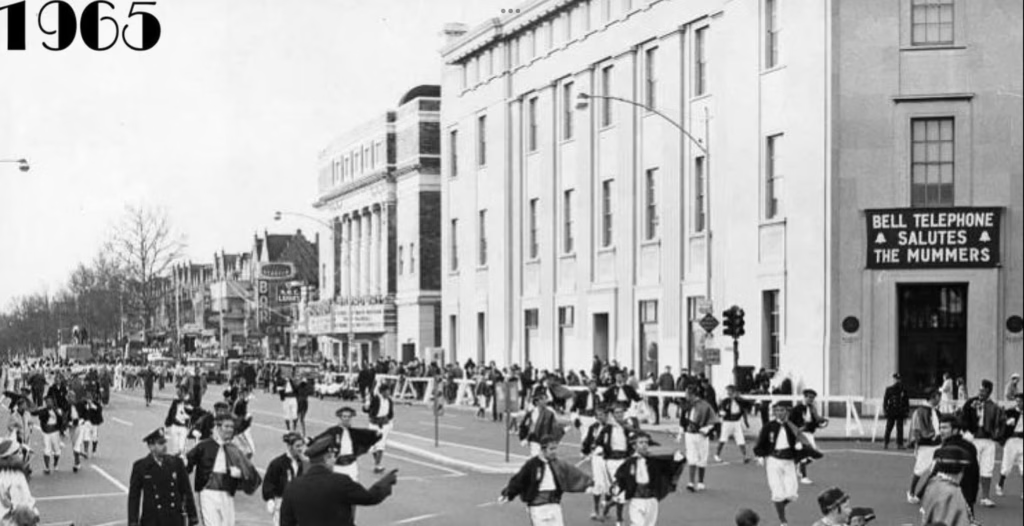
Growing up here in the 1950s and 1960s, I remember when the southwest corner of Broad and Passyunk was home to the Bell Telephone building, where families went to pay their phone bills at the counter. Down the block stood the old Broadway movie house, a weekend favorite for neighborhood kids. We could often get free tickets from Bambi’s Dry Cleaners on Broad and Porter Streets, but even if we didn’t, it only cost 25 cents for a Saturday double feature and cartoons.
The Melrose Diner, at 15th and Passyunk, was known citywide for its buttercream cake and hot apple pie with vanilla sauce — true South Philly comfort food. My mother-in-law was a member of Holy Ghost Byzantine Catholic Church, where her father — my wife’s grandfather — served as a priest. My father-in-law was also from St. Monica’s, which is where my wife and I later lived, met, and were married at St. Monica’s Church.
My wife’s uncles owned and operated Runtagh Funeral Home on Passyunk Avenue — a family-run business that served South Philadelphia for decades with compassion and dignity.
While the phone company, the Broadway, and the Melrose are now gone, the memories of those places — and of the generations who built this community — continue to define the heart and character of West Passyunk Avenue today.
The 1965 Mummers Parade: A South Philly Tradition
The black-and-white photograph above captures a moment from the 1965 Mummers Parade — one of Philadelphia’s most beloved New Year’s Day traditions. For generations, South Philadelphians lined Broad Street to watch costumed brigades, string bands, and comic clubs march north from Broad and Oregon Avenue all the way to City Hall. The route has changed over the decades, but the excitement, neighborhood pride, and sense of community remain as strong as ever.
In the 1960s, these parades represented the heart of South Philly — a celebration of family, creativity, and working-class spirit. The Mummers were more than performers; they were neighbors, uncles, fathers, and lifelong friends who spent all year building floats, sewing costumes, and rehearsing routines in nearby clubhouses. Their performances brought color, laughter, and togetherness to the cold streets of January. Even today, the Mummers Parade continues to unite Philadelphia with that same unmistakable South Philly enthusiasm, echoing the pride that still defines the surrounding neighborhoods.
This article is part of our Philadelphia Neighborhood Safety Guide, which examines traffic patterns and accident risks across neighborhoods throughout the city.
Understanding West Passyunk Avenue
Passyunk Avenue is a diagonal thoroughfare in South Philadelphia that’s divided by Broad Street into two distinct sections: East Passyunk and West Passyunk.
-
- East Passyunk runs from Broad and McKean to 5th and Bambridge, lined with restaurants, shops, and the Italian Market’s heritage.
-
- West Passyunk runs between Broad Street and 25th Streets, roughly bounded by Mifflin Street to the north and West Passyunk Avenue itself to the south. This section is more residential — a blend of homes, small parishes, and family-owned businesses that have stood for generations.
That diagonal route makes Passyunk unique — it slices across Philly’s tight grid system, linking Oregon Avenue, Snyder, and Broad Street. For locals, it’s a convenient cut-through; for commuters, it’s often a faster way toward I-76 or the stadiums. But with that convenience comes a cost: heavier traffic, complex intersections, and an increased risk of accidents.
Traffic and Safety Challenges
West Passyunk Avenue’s angled layout and narrow lanes create regular congestion — especially at Broad Street and near 17th and Snyder. Residents describe drivers cutting through side streets, double-parking near stores, and speeding between stop signs.
Common Safety Concerns
-
- Cut-through traffic from Broad Street toward I-76
- Pedestrian hazards at unmarked or mid-block crossings
- Double-parking during rush hours and church services
- Motorcycle and bicycle risks along the corridor
- Overflow from stadium events, pushing traffic westward
Philadelphia crash data shows that West Passyunk Avenue and Broad Street remain among the most collision-prone intersections in South Philly. When accidents occur along busy neighborhood corridors like West Passyunk Avenue, understanding your legal rights and the steps to take afterward can help protect you and your family.
Similar traffic and pedestrian safety concerns appear at nearby intersections such as Broad & Oregon, one of South Philadelphia’s busiest traffic corridors.
Accident Risks and Legal Awareness Along West Passyunk Avenue
Because West Passyunk Avenue blends residential streets, neighborhood businesses, and commuter traffic, several types of accidents can occur in this corridor:
-
Car and pedestrian accidents
-
Slip-and-fall injuries outside shops or restaurants
-
Parking-lot collisions
-
Delivery-driver and rideshare incidents
-
Negligent property maintenance claims
Understanding how and where accidents occur along busy neighborhood streets can help residents and visitors stay aware of potential risks.
If you or a family member is injured in an accident in South Philadelphia, it is important to understand your legal options and the steps that may protect your rights.
Landmarks: Past and Present
Holy Ghost Byzantine Catholic Church
2310 South 24th Street, Philadelphia, PA 19145
This Byzantine Catholic parish near 24th and Passyunk has long been a spiritual anchor in South Philly. Its distinctive domes and choir tradition reflect the neighborhood’s Eastern European roots. holyghostbyzantine.com
Ruffenach Funeral Home
A family-operated funeral home serving the community for decades, providing compassionate care to South Philadelphia families.
Philip’s Steaks
2234 W. Passyunk Avenue, Philadelphia, PA 19145
A South Philly staple known for its “slab” of steak and late-night service — a true corner cheesesteak tradition. sqphilipssteaks.com
St. Monica Bowling Lanes
1601 W. Shunk Street, Philadelphia, PA 19145
Part of St. Monica’s Parish, this friendly bowling alley has hosted generations of neighborhood families. stmonicabowling.com
Runtagh Funeral Home (Historic)
Once run by my wife’s uncles, Runtagh’s was a well-known South Philly institution for decades, remembered for its compassion and deep parish ties.
The Old Atlantic Thrift Store (Historic)
A neighborhood favorite now gone — but part of a retail tradition carried on by shops along East Passyunk Avenue.
Remembering West Passyunk’s Golden Era
There’s something unmistakable about the rhythm of life here — the sound of buses turning at Broad Street, the smell of fresh rolls from corner bakeries, and families gathering at Melrose after church.
For generations, West Passyunk Avenue has been more than a shortcut — it’s been home. The same sidewalks that carried grandparents to work now lead their grandchildren to coffee shops and schools. Though much has changed, the spirit of South Philadelphia — pride, resilience, and connection — remains stronger than ever.
Girard Estate: A Neighbor to West Passyunk’s Legacy
Just beyond West Passyunk Avenue lies the Girard Estate neighborhood — one of South Philadelphia’s most distinctive and enduring communities. Stretching from 17th and Shunk through 22nd Street up to Passyunk Avenue, this area was long considered one of the most exclusive sections of South Philly, and it still carries that prestige today. The homes, with their unique architecture and tree-lined streets, stand as a testament to early 20th-century urban planning and craftsmanship.
As summarized by Google’s AI overview:
“The Girard Estate is a South Philadelphia neighborhood developed from lands owned by philanthropist Stephen Girard, who in his 1831 will left a massive fortune to fund a boarding school for poor, white, male orphans called Girard College. The neighborhood was built to generate income for the college, featuring a planned community with unique homes, a power plant, and local amenities. The college, established by Girard’s bequest, opened in 1848 and has since evolved into a modern college preparatory school, admitting girls and students from low-income, single-parent homes.”
Today, Girard Estate remains one of Philadelphia’s architectural gems — a quiet, dignified enclave surrounded by the energy of West Passyunk and the nearby stadium district. The continuity of its design and the pride of its residents help preserve a piece of Philadelphia’s history while complementing the vibrant, working-class neighborhoods that surround it.
For readers who want to learn more about safety concerns and what steps to take after an accident in this historic neighborhood, see our guide: What to Do After an Accident in Girard Estate, Philadelphia.
Resources for Residents & Visitors
Frequently Asked Questions
Where is West Passyunk Avenue in South Philadelphia?
West Passyunk Avenue runs through South Philadelphia and connects several residential blocks, neighborhood businesses, and busy commuter corridors.
Why can accidents happen on West Passyunk Avenue?
Accidents can happen because West Passyunk Avenue cuts diagonally through the street grid, creating complex intersections, turning conflicts, pedestrian activity, and congestion.
Are pedestrian accidents a concern on West Passyunk Avenue?
Yes. Pedestrian accidents can happen where local foot traffic, parked cars, delivery vehicles, and turning drivers reduce visibility along neighborhood corridors.
Do rideshare and delivery vehicles increase traffic risks in South Philadelphia?
They can. Uber, Lyft, food delivery drivers, and other commercial vehicles often make sudden stops, pickups, and turns that add to congestion and increase accident risks.
What should I do after an accident in South Philadelphia?
Seek medical attention right away, document the scene if you can, report the incident when appropriate, and understand your legal options as early as possible.
Why is West Passyunk Avenue considered a unique South Philadelphia corridor?
West Passyunk Avenue combines neighborhood history, residential traffic, local businesses, and diagonal street patterns that make it different from many other South Philadelphia streets.
He served as an official court reporter in the Philadelphia Court of Common Pleas and the United States District Court for the Eastern District of Pennsylvania, developing a front-row understanding of how injury cases are investigated, documented, and presented.
Thomas does not provide legal representation through this site. When legal help is needed, readers are directed to The Oakes Firm.
Reading this content does not create an attorney–client relationship.
For advice about your specific situation, consult a qualified attorney in the appropriate jurisdiction.
(215) 883-4412