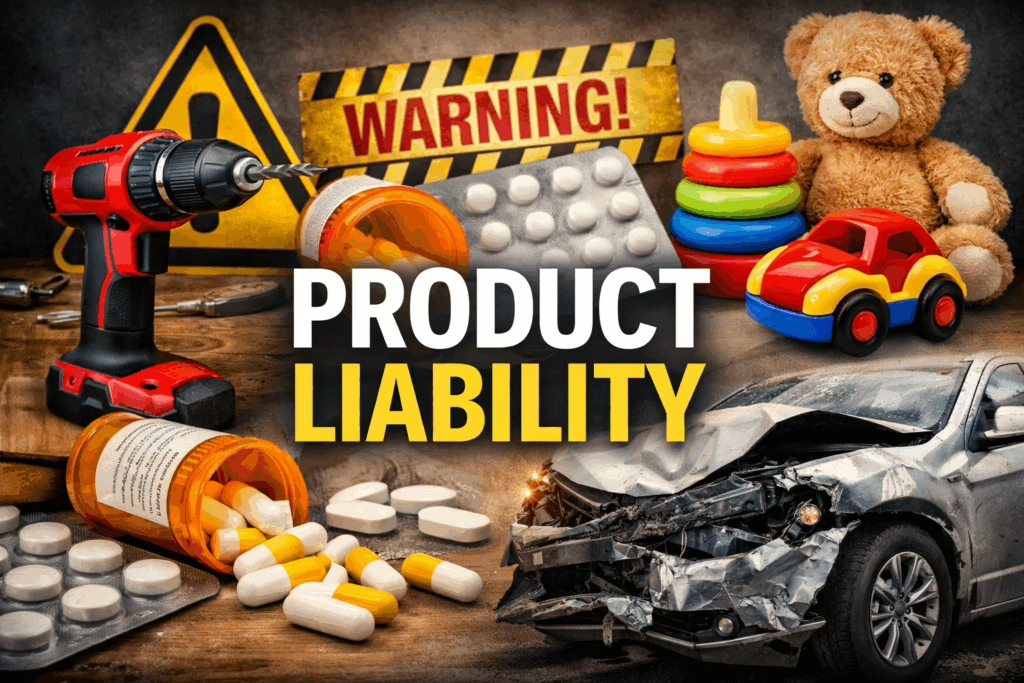
Defective Products, Common Claims, and What to Do After an Injury
Quick Answer
If a product injured you in Pennsylvania (Philadelphia and the suburbs) or New Jersey (South Jersey and the Shore), you may have a product liability claim if the product was:
- Defectively designed,
- Manufactured incorrectly, or
- Sold without adequate warnings or instructions
and that defect caused your injury during intended or reasonably foreseeable use.
Best first move: Get medical care, preserve the product and packaging, and talk to counsel quickly. Product cases often turn on evidence, timelines, and experts.
If you’re looking for product liability Philadelphia guidance, this post explains the defect types, proof, deadlines, and first steps that protect your claim.
Key Takeaways
- Three core defect types: design defects, manufacturing defects, and failure-to-warn (labeling/instructions).
- More than one company can be responsible: manufacturers, component-part makers, distributors, retailers, installers, and repair companies—depending on what failed and why.
- What typically must be proven: a defect existed, it was present when the product left the defendant’s control, and it caused injury during intended or foreseeable use.
- Evidence wins product cases: keep the product, packaging, manuals, receipts, broken pieces, and photos—don’t repair it or throw anything away.
- Time limits matter in PA & NJ: many injury claims have a two-year deadline, and delays can destroy evidence and make it harder to identify every responsible party.
If you want a broader checklist you can follow across most injury situations (including defective products), start here: Philadelphia Injury Playbook.
Editor’s Note: Most people don’t think about product safety until something goes wrong. Defective products can show up anywhere—your car, your home, a child’s toy, a Shore rental, a tool at work, or even labeling on medicine. The common thread is this: product cases are built on proof. Preserving the product and documenting what happened is often the difference between a “maybe” and a claim you can actually prove.
From the courtroom: I watched many “PC Triple F” cases in the 1980s—post-collision fuel-fed fires involving devastating fuel-tank fires. They taught me a core truth: product cases are expert cases. Metallurgists and engineers often make the difference between a theory and a provable defect.
— Thomas G. Oakes
Introduction
Product liability lawyers represent individuals injured by dangerous or defective products. These cases can become complicated quickly because the product may be designed in one state, made in another, and sold or used in Pennsylvania or New Jersey. Serious cases often involve large corporate defendants, technical evidence, and expert testimony.
This guide explains how defective product claims generally work for people in Pennsylvania and New Jersey, what products are covered, who can be held responsible, how these cases are proven, and what to do right away if you suspect a product caused your injury.
Defining Product Liability
Product liability is the body of law that can hold businesses financially responsible when a product defect causes injury. In many cases, the focus is not “who was careless,” but whether the product was not reasonably safe and whether that defect caused harm. In product liability Philadelphia cases, the focus is often on whether the product was defective and whether that defect caused injury.
Depending on the facts, product cases may involve claims such as:
- Design defect
- Manufacturing defect
- Failure to warn (inadequate warnings or instructions)
- Breach of warranty (express or implied promises about safety or performance)
- Negligence (such as negligent testing, inspection, or quality control, where applicable)
- Misrepresentation (marketing or instructions that materially misstate safety or proper use)
Regulatory standards can matter. Many products are influenced by safety oversight and reporting systems (consumer recalls, vehicle standards, drug/device labeling rules). Compliance can be important evidence, but it does not automatically end liability. A product can meet a minimum standard and still be unreasonably dangerous in real-world foreseeable use.
What Products Are Covered?
Claims can arise from a wide range of products, including (but not limited to):
- Automobiles and auto parts: airbags, seat belts, roof strength, tires, brakes, child restraints
- Machinery and tools: guards/interlocks, saws, presses, ladders, scaffolding, nail guns
- Consumer products: appliances, space heaters, extension cords, batteries/chargers, furniture tip-overs
- Pharmaceuticals and medical devices: labeling/warnings, instructions, known risks and contraindications
- Toys and children’s products: choking hazards, tip-overs, defective materials
- Food products: contamination or packaging/labeling issues (depending on the facts)
Local note: In Philadelphia and South Jersey, defective product injuries show up in everyday settings—cars and parts, appliances, space heaters, extension cords, lithium-ion batteries and chargers, e-bikes/scooter rentals, tools, ladders, and children’s products. At the Shore, seasonal spikes often involve rental items and vacation-home equipment that hasn’t been properly maintained.
Defective Products in South Jersey & the Jersey Shore
Defective product injuries don’t just happen in Philadelphia. Every summer, South Jersey and Jersey Shore visitors encounter defective rental equipment, faulty appliances, unsafe deck furniture, defective e-bikes and scooters, damaged ladders, and poorly maintained vacation-home equipment.
If your injury occurred in Atlantic City, Ocean City, Wildwood, Cape May, Sea Isle City, Avalon, Stone Harbor, or another South Jersey community, visit our comprehensive guide:
Types of Product Defects
Most product liability Philadelphia claims fall into three categories: design defect, manufacturing defect, or failure to warn.
1) Design Defects
A design defect exists when a product is dangerous because of how it was designed—before it was ever made. Even if every unit matches the blueprint, the blueprint itself may be unsafe. Examples include unstable furniture that tips over, machines lacking guards where foreseeable misuse is likely, or designs that create predictable failure modes.
2) Manufacturing Defects
A manufacturing defect occurs when something goes wrong during production or assembly—substandard materials, wrong parts, contamination, missing fasteners, poor welds, improper torque, and similar issues. A single batch can be defective even if the overall design is safe.
3) Failure-to-Warn (Warnings and Instructions)
Some products have inherent risks that can be reduced by clear warnings and proper instructions. A failure-to-warn claim may involve missing warnings, unclear warnings, warnings that don’t match foreseeable real-world use, or instructions that fail to explain known hazards. Medication and medical-device labeling disputes often fall into this category.
Who Can Be Held Responsible?
Liability can extend up the chain of distribution. Depending on what went wrong, potentially responsible parties may include:
- The manufacturer of the finished product
- A component-part manufacturer (when a part defect causes failure)
- Distributors and wholesalers
- Retailers (including some online sellers, depending on the facts)
- Installers, maintenance companies, or repairers (when improper installation/repair created or worsened the hazard)
In other words: product liability is not always “one defendant, one product.” Serious cases often require identifying every company that touched the product—from design and manufacturing, to distribution and sale, to installation and servicing. A product liability Philadelphia claim may involve multiple responsible parties across the chain of distribution.
What Product Liability Lawyers Actually Do
Product liability attorneys build the proof. That usually includes:
- Investigating the incident and how the failure occurred
- Preserving key evidence (product, packaging, broken parts, receipts, photos, data)
- Working with experts (engineering, human factors, warnings/labeling, medical causation, economics)
- Identifying all responsible parties in the supply chain
- Navigating multi-state issues (where the product was made, sold, and used; which law applies; where to file)
- Handling large corporate defendants and technical defenses
How Product Liability Claims Are Proven
Successful product claims typically require proof of these core elements:
- Defect: the product was defective (design, manufacturing, or warnings/instructions).
- Timing: the defect existed when the product left the defendant’s control (or at the responsibility point in the distribution chain).
- Causation: the defect caused the injury.
- Foreseeable use: the product was used as intended or in a reasonably foreseeable way.
- Damages: you suffered measurable harm (medical care, lost wages, pain and suffering, disability, etc.).
How “Defect” Is Evaluated (Plain English)
Courts and experts often evaluate defect questions using concepts like:
- Consumer expectations: did it perform as safely as an ordinary consumer would expect during intended or foreseeable use?
- Risk–utility: did the risks outweigh the benefits given what was feasible at the time?
- Reasonable alternative design: was there a practical alternative design that would have reduced risk without destroying usefulness?
Why experts matter: many product cases require engineers, warnings experts, medical experts, or industry specialists to explain what failed, why it failed, and how it caused the injury.
What To Do Right Away (Evidence & Safety Checklist)
If you believe a defective product caused your injury:
- Get medical care immediately. Your health comes first—and records help connect the event to your injuries.
- For a step-by-step overview of what to do next (medical documentation, photos, and dealing with insurance), see our guide: What to do after an accident in Philadelphia.
- Preserve the product and everything that came with it. Keep the product, broken parts, packaging, manuals, inserts, labels, batteries/chargers, and accessories.
- Don’t repair, alter, or “test” the product after the incident. Changes can destroy evidence and create chain-of-custody problems.
- Take photos and video. Capture the product, scene, serial/model numbers, warning labels, and the failure point.
- Save proof of purchase and ownership. Receipts, order confirmations, warranty cards, emails, installation invoices, and maintenance/repair records.
- Write down what happened while it’s fresh. Date/time, what you were doing, who was present, and what the product did right before failure.
- Identify witnesses. Names, phone numbers, and what they observed.
- If the product uses an app or stores data, preserve that too. Keep screenshots, error logs, app version info, and don’t delete the app.
- Check for recalls—but don’t throw anything away. A recall may help support the claim, but the product itself remains critical evidence.
Compensation (Damages) in Product Liability Cases
Compensation depends on the facts, the forum, and the injury severity. In general:
Economic damages (financial losses)
- Past and future medical expenses
- Lost wages and diminished earning capacity
- Out-of-pocket costs related to the injury
- Property damage (when applicable)
Non-economic damages (human losses)
- Pain and suffering
- Emotional distress
- Disfigurement and scarring
- Loss of enjoyment of life
- Loss of consortium (in some cases)
In catastrophic injury or wrongful death cases, damages often require medical and economic experts to quantify long-term losses.
PA & NJ Time Limits (Statutes of Limitation / Repose)
Do not wait. Product cases often involve fast-moving investigations and multiple potentially responsible parties. Waiting can jeopardize the claim and the proof.
Pennsylvania (general rule)
Many personal injury claims must be filed within two years (commonly referenced under 42 Pa.C.S. § 5524). Exceptions can apply depending on the facts (for example, discovery issues, minors, and other special circumstances).
New Jersey (general rule)
Many personal injury claims must be filed within two years (commonly referenced under N.J.S.A. 2A:14-2). Factors can alter time periods, so case-specific guidance matters.
Important note on the “10-year statute of repose” in New Jersey
People sometimes hear “10-year statute of repose” and assume it applies to every defective product claim. In New Jersey, the well-known 10-year statute of repose is primarily tied to certain claims involving improvements to real property (construction/design/installation). It is not a blanket cutoff for every consumer product case.
That said, it can become relevant if the injury involves something installed as part of a building improvement (for example, certain building equipment or systems), and it may affect claims against construction-related defendants.
Bottom line: get advice early so the right deadlines are identified, evidence is preserved, and every responsible party is investigated before proof disappears.
Get Connected with The Oakes Firm
Frequently Asked Questions:
Below are common product liability Philadelphia questions we hear from people injured by defective products.
What qualifies as a “defective” or “unreasonably dangerous” product?
A product may be considered defective if it does not perform as safely as an ordinary consumer would expect during intended or reasonably foreseeable use, or if its risks outweigh its benefits given feasible safer designs, proper manufacturing controls, or adequate warnings and instructions.
Do I have to prove the manufacturer was negligent?
Not always. Many product cases focus on whether the product was defective and whether that defect caused the injury. Depending on the facts, additional theories (including negligence or warranty issues) may also apply.
Who can be sued in a product liability case?
Potential defendants may include the manufacturer, a component-part maker, distributors/wholesalers, retailers, and sometimes installers or repair companies—depending on where the defect originated and who had control over the product at key points.
What if the product was recalled?
A recall can help show that a product had known problems, but it does not automatically prove your individual claim. Preserve the product and evidence either way—your case still requires proof of defect and causation.
What if I threw the product away or it was fixed after the incident?
You should still speak with counsel. While preserving the product is ideal, other evidence may exist (photos, videos, packaging, purchase records, witness statements, medical records, similar-incident evidence). But the sooner you act, the better your chances of proving what happened.
What injuries are commonly involved in defective product cases?
Defects can cause burns, lacerations, broken bones, traumatic brain injury, eye injuries, electrocution, poisoning, crushing injuries, amputations, carbon monoxide injuries, spinal cord injury, and more.
What if I used the product “wrong”?
A case may still exist if your use was reasonably foreseeable—even if not perfect. But substantial misuse or major modification can complicate causation and responsibility.
How long do I have to file a defective product claim in PA or NJ?
Many personal injury claims have a two-year deadline in both Pennsylvania and New Jersey, but exceptions and special rules can apply depending on the facts. Because evidence can disappear fast, it’s best to get advice as early as possible.
What should I bring to a consultation?
Bring the product (if you have it), packaging/manuals, proof of purchase, photos/video, witness info, repair/maintenance records, and medical records so far. For large products (vehicle, appliance, building equipment), bring documentation and photos.
What should I do right after a defective product injury?
Get medical care, save the product and packaging, take photos, keep receipts/manuals, and avoid repairs or further testing. Product cases often turn on early evidence.
How much does it cost to speak with a product liability lawyer?
Most injury firms handle product cases on a contingency fee (no fee unless there’s a recovery), but terms vary. A quick consultation can clarify the fee arrangement and next steps.
Do I need the receipt to bring a claim?
Not always. Receipts help, but claims can sometimes be proven with other evidence (photos, serial numbers, packaging, witness statements, warranty records, bank/online order history).
Related Injury Guides
Looking for additional injury and safety resources? Start with these guides:
- Philadelphia Injury Playbook — Step-by-step guidance after an accident.
- South Jersey & Jersey Shore Injury Guide — Injury risks, vacation accidents, boating incidents, rental property hazards, and more.
- Philadelphia Neighborhood Safety Guide — Local traffic patterns, dangerous intersections, and neighborhood-specific safety concerns.
Core PhillyLegalConnect Resources
Explore PhillyLegalConnect’s primary guides for rideshare accidents, South Jersey and Jersey Shore injuries, and practical steps to take after an accident.
Philadelphia Neighborhood Safety • Philadelphia Nostalgia • About PhillyLegalConnect • Home
Need legal representation after an accident?
Get Connected With The Oakes Firm →